
Dual mass wheel – what is it and what is it used for?
Increasingly, we are seeing a trend that involves reducing the size of the engine, for example, a six-cylinder is being replaced by a four-cylinder. Hence, a small vibration damper is not sufficient for new-generation engines, as we now have a different type of vibration. This is precisely the task that the dual mass flywheel or, colloquially, the dual mass flywheel fulfills these days.
History of the dual mass flywheel
In four-stroke reciprocating engines, the periodic sequence of four cycles (intake, compression, work, exhaust) combined with the ignition sequence of individual cylinders leads to rotational irregularities of the crankshaft and the combined flywheel.Since the drive train is caused by inertia and the stiffness contained in it, the structure of torsional vibration (with characteristic natural frequencies) introduced by the rotational irregularities of the engine inevitably leads to torsional vibration. These can be constructively reduced.
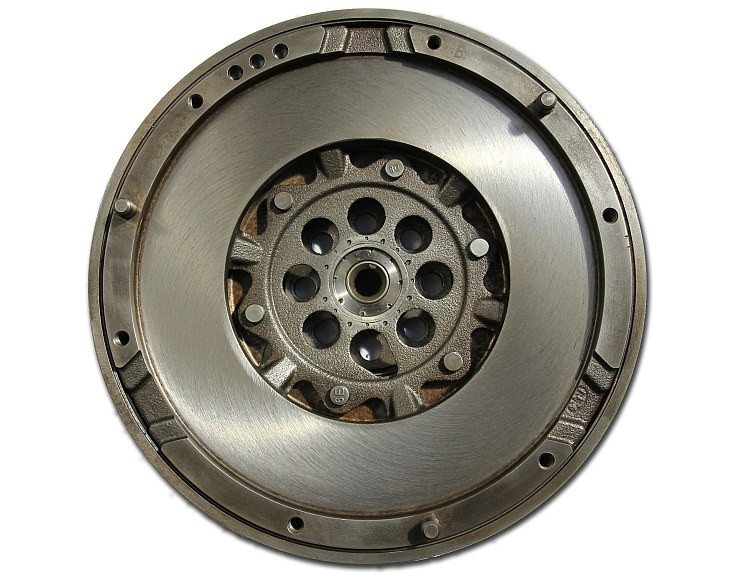
In the past, only torsional damper clutches were used to reduce torsional vibration. In 1985, LuK introduced the first dual-mass flywheel. While a conventional internal combustion engine flywheel consists of parts of the crank mechanism, flywheel and clutch, the dual mass flywheel is divided into a primary flywheel (engine side) and a secondary flywheel (transmission side), which are connected to each other by spring-loaded dampers.
Structure of the dual mass flywheel
The dual mass flywheel – as the name suggests – is built from two masses. The primary mass contains the starter rim and the arc springs located inside the wheel. The secondary mass, on the other hand, is equipped with a driver disc which ends in a buffer located between two arc springs.

The secondary mass is closely connected to the flywheel disc. The rotating masses are connected to each other. A large and small ball bearing allows rotation albeit a plain bearing is the standard these days. The flange has additional masses – weights that absorb energy from vibration through counter-rotation. That’s why each dual-mass wheel-or as some prefer to call it a dual-capacitor wheel-is customized for each engine and vehicle.
Advantages of a dual-mass wheel
- Vibration decoupling throughout the speed range
- High acoustic comfort (smoother transmission operation, less excitation of the vehicle structure)
- Protection of the gearbox by reducing peak torques
- Reduction in fuel consumption due to low speed and in the lower speed range
- Longer life of drivetrain components
- Low space requirements – about the same as a dual clutch
Disadvantages of the dual mass wheel
- Lower mileage when used with a standard clutch
- High repair costs
- Thermal stress
- Limited torque
Sources:
https://reparts.pl/sklep/kategoria/kola-dwumasowe/
https://de.wikipedia.org/wiki/Zweimassenschwungrad
https://www.schaeffler.de


